

How AI Levels the Field for Journalists — And Where It Falls Short
I’ve lost count of how many times I’ve heard some version of this:
“If I let AI help with my writing, am I still a real journalist?”
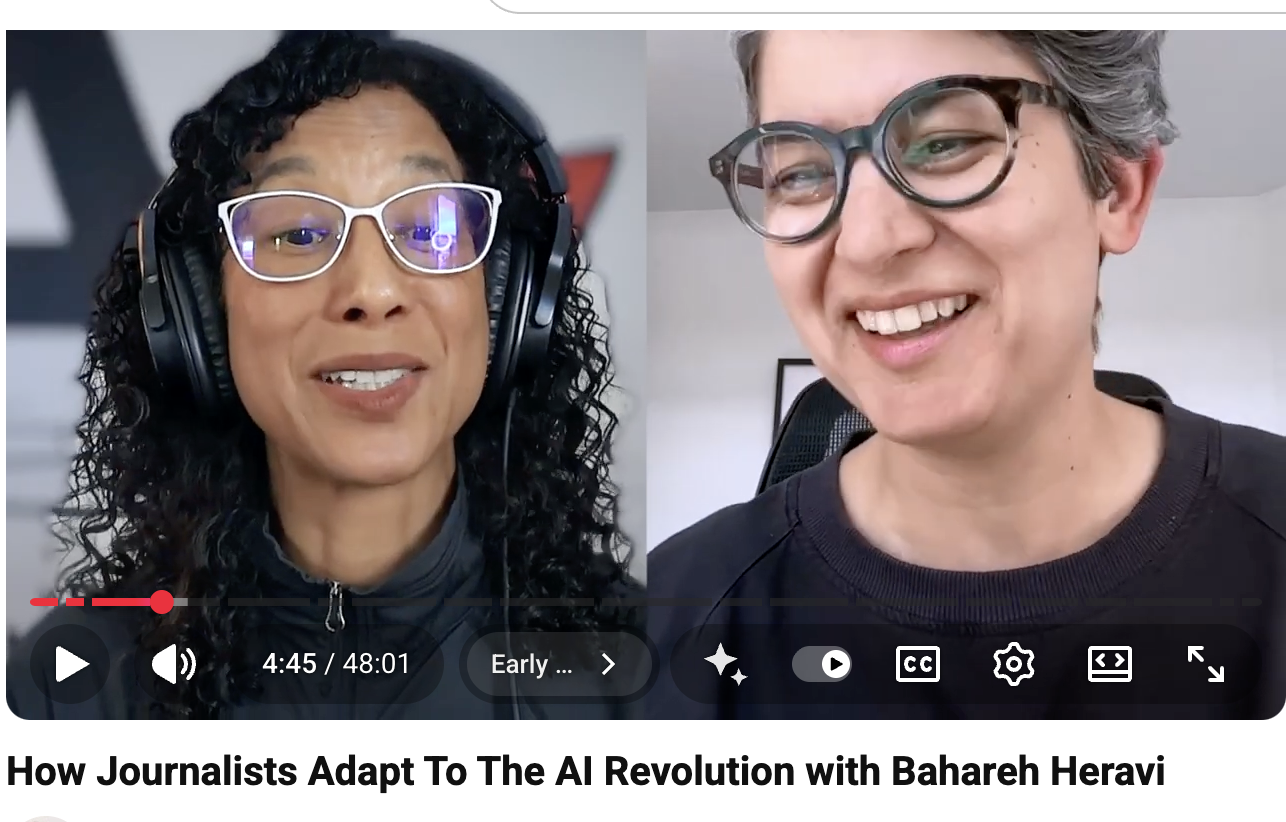
On a recent episode of A Journalist’s Guide to AI, I talked with Dr. Bahareh Heravi about AI in the newsroom. We covered policy, data, tools — all the usual suspects.
But one idea stuck with me:
AI as a language equalizer.
Bahareh talked about journalists who are excellent writers in their own language, then move into an English-language newsroom and suddenly get treated like “weaker” writers. Their reporting didn’t change. The language did.
That’s the kind of barrier I care about. And I just saw it up close in Laos.
When “good English” quietly becomes a gatekeeper
In a lot of newsrooms, polished English (or whatever the dominant language is) becomes an unspoken filter:
- Native speakers get read as “strong writers.”
- Reporters working in a second or third language get judged on their grammar before anyone really looks at their reporting.
On that episode, Bahareh and I went deep on this idea of AI helping to level that playing field.
Then it showed up again in my Fulbright work.
While teaching journalists in Laos, some of my students were using Gemini and ChatGPT to translate their stories from Lao to English. The results were impressive — and revealing. The English versions sounded polished yet oddly formal, full of academic phrases no working reporter would actually write.
We ended up talking about why conversational clarity matters more than textbook correctness. The students could feel the difference immediately. They knew when a sentence sounded like them and when it sounded like a scholarship application. They just needed tools and language to bridge that gap.
I see a version of this at San Francisco State, too. I’ll read a draft and think:
- The story idea is solid.
- The sourcing is smart.
- The language is getting in the way.
For years, that meant a lot of line-editing:
- “Move your verb up.”
- “Cut this clause.”
- “Turn this into a simple sentence.”
Now a student can drop a paragraph into an AI tool and say:
“Rewrite this in clear news style at an 8th–10th grade reading level. Keep my facts and quotes.”
The reporting is still theirs. The decision-making is still theirs. The tool just removes a penalty that honestly never should have existed in the first place.
That, to me, is a legitimate use of AI.
AI as a ramp, not a replacement
Let me be clear: I’m not arguing that AI should write the story for you.
I’m saying:
- If English isn’t your first language,
- If you weren’t trained in U.S. newswriting style,
- If you’re a brilliant reporter whose sentences just come out a little tangled,
then using AI to help clean up grammar, tighten structure, and simplify phrasing is not cheating.
You’re still:
- Choosing the story
- Finding the sources
- Asking the hard questions
- Making the ethical calls
AI is just another tool in your kit — like spellcheck, like a style guide, like that one editor who can slice a paragraph in half and somehow make it stronger.
The danger isn’t in letting AI help.
The danger is in letting AI take over.
The other power track: data and computational skills
Bahareh and I also talked about another kind of access problem in journalism: data and computation.
For years, the message was:
“Journalists need to learn data. Journalists need to learn code.”
And that opened doors. Data journalism revealed stories no one could see before.
Now AI adds another layer:
- Reporters can use AI to help with spreadsheets, simple analysis, and cleaning messy datasets.
- Data folks in newsrooms can use AI to help turn complex work into clearer, more readable copy.
That doesn’t mean “let the machine do the journalism.”
It means:
- You don’t have to be a perfect writer and a perfect coder to contribute.
- AI can help people on both sides meet in the middle — as long as the editorial judgment stays human.
Used that way, AI doesn’t replace anyone. It makes room for more kinds of talent.
Let’s be honest: AI text often sounds fake
Now for the part people whisper about but rarely say out loud on stage:
A lot of AI-generated writing sounds the same.
Editors can smell it.
You’ve seen it:
- The same smooth, neutral tone.
- The same filler phrases: “in today’s world,” “ever-changing landscape,” “it’s important to note,” “on the other hand.”
- Paragraphs that glide along and say almost nothing.
If you hand AI your entire story, copy-paste the result, and hit publish, here’s what happens:
- Your voice disappears.
- Your lived experience disappears.
- Your work starts to sound like a thousand other AI-assisted pieces.
So yes, AI can help with language and structure.
It can also sand off every rough edge that makes your writing yours.
That’s the tradeoff we have to name.
So, where’s a reasonable line for journalists?
Here’s where I draw it for myself:
You’re still doing real journalism if you:
- Do your own reporting and verification.
- Make the ethical decisions yourself.
- Use AI to tighten language, simplify structure, translate or rephrase.
- Edit the AI output hard so it sounds like you, not like a brochure.
You’re on thin ice if you:
- Let AI decide what the story is.
- Use it to invent quotes, scenes, or sources.
- Publish the output without checking for vagueness, cliché, or inaccuracies.
- Stop doing the thinking and become a prompt operator instead of a journalist.
Used wisely, AI can:
- Help journalists working in a second language get a fair reading.
- Help students who were never taught “news style” find their footing faster.
- Help data people communicate their findings in a way audiences actually understand.
Used lazily, it flattens your voice into something your editor has absolutely seen before.
If any of this hits close to home — because you’re reporting in a second language, you’re teaching the next generation, or you’re the editor spotting AI-speak from a mile away — listen to the full conversation with Dr. Bahareh Heravi on:
🎧 “How Journalists Adapt To The AI Revolution with Bahareh Heravi” on A Journalist’s Guide to AI.
And if your newsroom or classroom is wrestling with how to use AI without losing your standards or your soul, that’s where my work lives now — through the podcast, my teaching, and my coaching.
You don’t have to pretend AI doesn’t exist.
You just have to decide who’s in charge: you, or the tool.
If you’d like me to work with your newsroom, class, or organization on using AI without losing your ethics or your voice, you can reach me at [email protected] or through the contact form on yumiwilson.me. I offer talks, workshops, and small-group trainings for journalists, editors, and educators.

Leave a Reply